
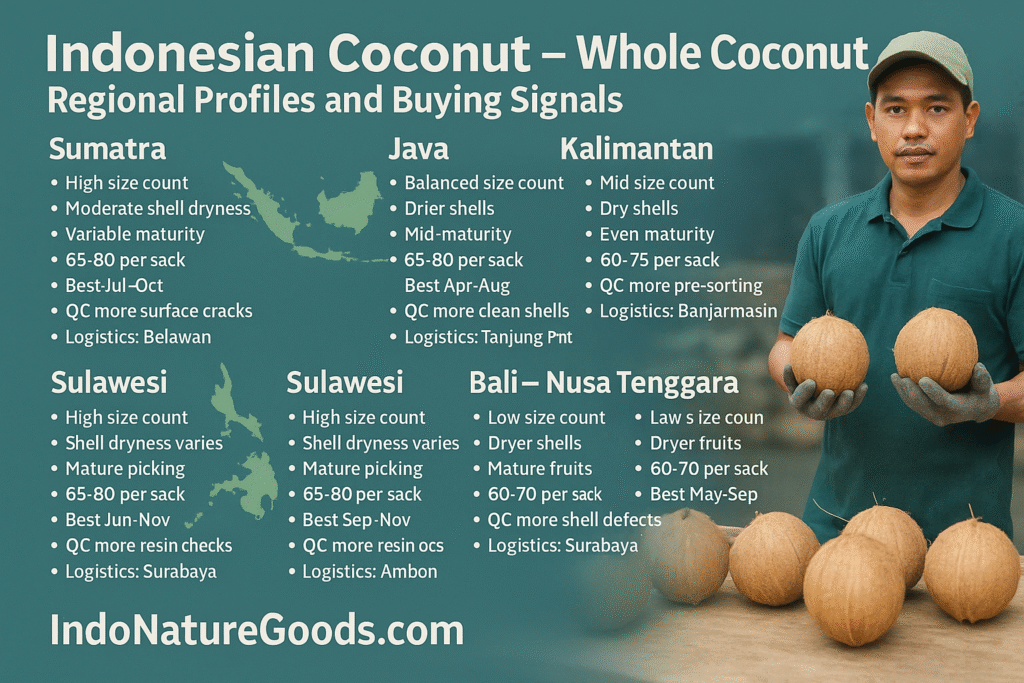
Indonesian Coconut — Whole Coconut Regional Profiles and Buying Signals | IndoNatureGoods.com

Understand Indonesian coconut regions for whole coconuts. See regional profiles, field cues, grade language, and simple intake checks for Sumatra, Java, Sulawesi, and Maluku. Product-only scope. Clear specs and region notes help B2B buyers plan volumes, seasons, and approvals with confidence.
Headline — coconut regional profiles that help buyers plan
Whole coconut supply improves when regions are mapped and signals are clear.
Introduction (hook, global context) — coconut planning by growing belt
Markets move with seasons. Therefore, we profile whole coconut from Sumatra, Java, Sulawesi, and Maluku. Consequently, procurement gains a steady plan with simple language.
The Global Demand (why this product is important) — coconut that stays consistent
Retail and foodservice value whole coconut for freshness and display. Moreover, region rotation protects counts. Hence, approvals speed up and waste falls.
Why Choose Indonesian coconut (Indonesia’s superiority) — depth across islands
Indonesia offers year-round whole coconut across multiple belts. As a result, buyers align volumes to real crop rhythms and hold programs through weather swings.
About IndoNatureGoods.com (supplier profile) — coconut sourcing discipline
We coordinate farm links, field sorting, and acceptance bands for whole coconut. Additionally, we publish region notes and availability signals that match your PO rhythm.
Product Range (whole only) — coconut scope and grade language
-
Mature coconut (brown coconut): whole; semi-husked or dehusked per SOP; size/weight bands S/M/L/XL.
-
Young coconut (green coconut): whole; trimmed to market style; bundle or carton counts fixed per order.
Scope remains whole coconut only. No derivative products.
Quality Assurance — coconut regional cues buyers should know
Whole coconut grading stays simple: shell integrity, cleanliness, size/weight band, and freshness cues. Furthermore, origin tags travel with the lot. Therefore, intake reads fast in every warehouse.
Sumatra coconut — profile and buying signals
Sumatra supplies broad whole coconut volumes most months. Crowns read tidy. Shell integrity tests well. Consequently, buyers lean on Sumatra for baseline counts and steady S/M/L bands.
Java coconut — profile and buying signals
Java provides balanced whole coconut flows with quick inland transfers. Trim on young fruit reads neat. Size variance remains low. Therefore, Java supports promo weeks and tighter calendars.
Sulawesi coconut — profile and buying signals
Sulawesi adds flexible capacity for whole coconut. Bands hold under pressure. Shells feel firm with good exterior cleanliness. As a result, teams use Sulawesi to cover spikes or short dips elsewhere.
Maluku coconut — profile and buying signals
Maluku delivers mature whole coconut with strong shell integrity. Crowns test consistent. Acceptance bands stay stable during routine weeks. Consequently, rejections trend low.
Coconut size and calibration — keeping regions uniform
Define S/M/L/XL by weight or circumference. Freeze the table at RFQ. Then print the same numbers on tickets. Moreover, set a clear ± tolerance per band. As a result, counts stay honest across belts.
Coconut acceptance bands — fast language for intake
-
Coconut shell & crown: no cracks; sound crown.
-
Coconut cleanliness: low surface soil; tidy trim on young fruit.
-
Coconut size/weight: match the band table; flag off-band pieces.
-
Coconut freshness cues: bright husk on young; dry husk and steady shake on mature.
These cues remove debate and shorten checks.
Why Choose IndoNatureGoods.com (reasons for choosing) — coconut regional strengths
-
One whole-coconut grade language across regions.
-
Region notes and weekly availability signals.
-
Clear band tables and visible tolerance windows.
The Human Side — coconut livelihoods behind the regions
Stable whole coconut orders support harvesting families and local graders. Training improves cut discipline and sorting speed. Income becomes steadier as calendars stay reliable.
How to Partner — coconut regional onboarding in five steps
-
Share whole coconut type, preferred regions, and weekly counts.
-
Lock S/M/L/XL bands with tolerance.
-
Approve the intake checklist and ticket format.
-
Set a rotation across Sumatra, Java, Sulawesi, and Maluku.
-
Run a pilot month; then expand to a quarterly plan.
Testimonials — coconut buyer remarks
“Region rotation kept whole coconut counts stable.”
“Band tables and tickets cut intake time to minutes.”
Future — coconut region labels and seasonal notes
Expect sharper origin tags and clearer week-by-week availability for whole coconut. Consequently, teams plan promos and store drops with fewer surprises.
Final Thoughts — coconut planning that holds
Map the regions. Fix the bands. Keep the ticket language short. With that focus, whole Indonesian coconut programs stay predictable and easy to approve.
FAQs (5) — coconut regions and buying signals
-
Which regions supply whole coconut most consistently? Sumatra and Java, with Sulawesi and Maluku as supports.
-
Can we lock weekly coconut counts by region? Yes—counts align to the rotation plan.
-
How do you keep coconut grading uniform across belts? One table, one ticket, and shared tolerance.
-
Do you supply only whole coconut? Yes—mature and young whole coconut only.
-
Can we shift coconut regions mid-program? Yes—subject to availability notes and weather.