
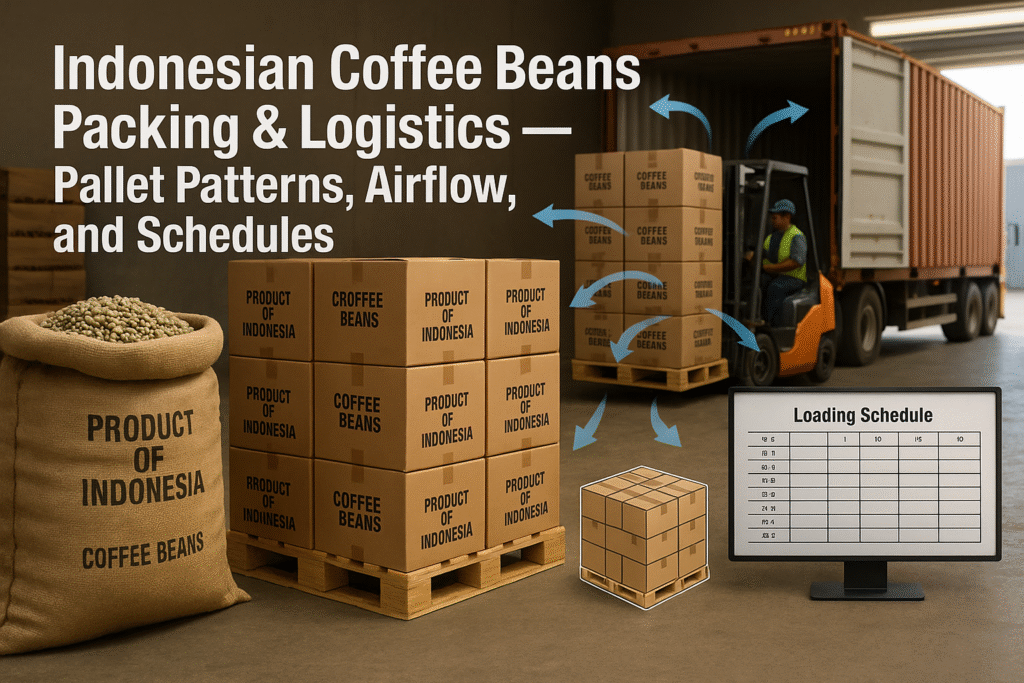
Indonesian Coffee Beans Packing & Logistics — Pallet Patterns, Airflow, and Schedules
Coffee beans packing introduction & route context
Coffee beans suffer from compression, heat, and moisture when pallets are packed for short distances but sent on long routes, therefore we design stacks that breathe, resist shifts, and keep labels legible even after multiple handoffs. Moreover, consistent patterns allow receivers to count quickly and put stock away without rework.
Global coffee beans demand for clean arrivals (why this matters)
Because roasting schedules are calendar-driven, dents or damp sacks cascade into production changes that burn labor and delay launches, so disciplined packing and routing is not a luxury but a measurable driver of cost and reliability. Consequently, partners now grade suppliers on arrival condition and claim frequency just as closely as they grade cup quality.
Why choose Indonesian coffee beans packing lanes (Indonesia advantages)
Indonesia ships across a dense set of ports and carriers, which provides backup sailings and pragmatic loading windows that can be tuned to the season, while experienced handlers document floors, walls, and seals so your claim files—should you need them—are thorough and easy to follow.
About indonaturegoods.com — coffee beans packing partner
IndoNatureGoods maps pallet footprints, defines airflow spacing, and prescribes corner boards, straps, and anti-slip sheets, then captures date-stamped photos, seal numbers, and container IDs in a neat folder so your team can compare plan versus execution at any time.
Coffee beans packing & stability (design details)
Coffee beans sacks, bag liners & label readability
We commonly use jute sacks with GrainPro liners where risk or route length suggests additional moisture protection, and we place large, high-contrast labels on outward faces so forklift drivers and receivers can verify lot IDs without cutting wrap.
Coffee beans pallet patterns, airflow and compression
Pallets are set with narrow aisle gaps to promote airflow while limiting voids that invite shifts, and compression is controlled through board and strap geometry that balances rigidity against carton or sack resilience.
Coffee beans container checks, VGM & sealing sequence
Before loading, teams inspect floors and walls, record VGM on schedule, and stage pallets for balanced weight distribution, after which the container is sealed and seal IDs are photographed alongside the lot ID for claim-ready evidence.
Coffee beans logistics & milestone planning (routing & payments)
Coffee beans routing, ports, and backup sailings
Routes are chosen for schedule stability and capacity signals, with a backup sailing identified to reduce rollover exposure during congestion or weather.
Coffee beans milestones & receiving prep
Release, gate-in, on-board, and ETA timestamps are published as they happen, allowing receivers to plan labor and space while minimizing demurrage and detention risk.
Coffee beans payments, Incoterms & file bundles
Incoterms: FOB/CFR/CIF; Payment: L/C or T/T; and every file—invoice, packing list, HS wording, COO, COA, and the bill of lading—sits with the photos and seals for straightforward reconciliation.
Why choose IndoNatureGoods for coffee beans logistics (benefits)
Because patterns, photos, and milestones are standardized and repeated, your claims fall while your calendar accuracy rises, which improves confidence with roasters and internal finance teams alike.
Beyond coffee beans (other coordinated exports)
We apply the same packing and routing rigor to skipjack tuna, ginger, birdnest, coconut, and squid, enabling single-SOP purchasing across categories.
The human side of coffee beans handling (impact)
Clear loading sequences reduce unsafe improvisation, while stable stacks and well-timed handoffs lower fatigue and overtime, thereby improving retention and morale in your logistics chain.
How to partner on coffee beans packing & logistics (onboarding)
Share route maps, sack or carton choices, pallet sizes, destination rules, and Incoterms, then we propose patterns, set buffers, and book space with full milestone visibility.
Coffee beans buyer testimonials for logistics (trust)
“Pallets arrived in spec with labels visible from the aisle,” and “Milestones matched the plan even in peak season,” are common notes from long-term partners.
Future of coffee beans packing & logistics (trend)
Expect smarter airflow modeling, greener bracing materials, and more granular milestone APIs that update internal dashboards automatically.
Final thoughts on coffee beans packing & logistics (close)
Design for airflow, plan for buffers, and document every seal, because a clean arrival today earns trust that multiplies across future purchase orders.
Coffee beans FAQs (5)
-
Which bags are typical? Jute sacks with optional GrainPro liners depending on route and risk.
-
How much airflow is needed? Narrow aisle gaps that ventilate without promoting shifts.
-
What evidence supports claims? Photos, seal IDs, container numbers, and milestone logs.
-
Which files travel? Invoice, packing list, HS wording, COO, COA, B/L, and photos.
-
Which Incoterms apply? FOB/CFR/CIF per contract.