
Indonesian Coconut — Whole Coconut Grades and Acceptance Bands | IndoNatureGoods.com
Learn Indonesian coconut grades for whole fruit. See acceptance bands, size/weight language, and simple field cues for mature coconut and young coconut. IndoNatureGoods.com maps regions, grade elements, defect lists, and intake checks. Product-only focus. No derivatives. Clear specs help buyers approve fast and plan volumes with confidence.
Headline — coconut grade language buyers can approve
Whole coconut moves faster when grades read the same in every lot.
Introduction (hook, global context) — coconut grading that speeds approvals
Buyers want clear, repeatable coconut rules. Therefore, we define acceptance bands, size/weight language, and visual cues in plain terms.
The Global Demand (why this product is important) — coconut quality signals at scale
Retail and foodservice rely on whole coconut presentation and freshness. Consequently, stable grading reduces waste and protects margins.
Why Choose Indonesian coconut (Indonesia’s superiority) — consistent field outcomes
Indonesia offers year-round whole coconut. As a result, graders apply one language across Sumatra, Java, Sulawesi, and Maluku.
About IndoNatureGoods.com (supplier profile) — coconut grade discipline
We align farm teams on shared coconut bands, simple tickets, and quick checks. Moreover, region notes keep calendars honest.
Product Range (whole only) — coconut grade scope and size language
-
Mature coconut (brown coconut): whole; semi-husked or dehusked per SOP; size/weight bands S/M/L/XL.
-
Young coconut (green coconut): whole; trimmed by market style; fixed counts per bundle or carton.
This scope remains whole coconut only.
Coconut grade elements — the field checklist
-
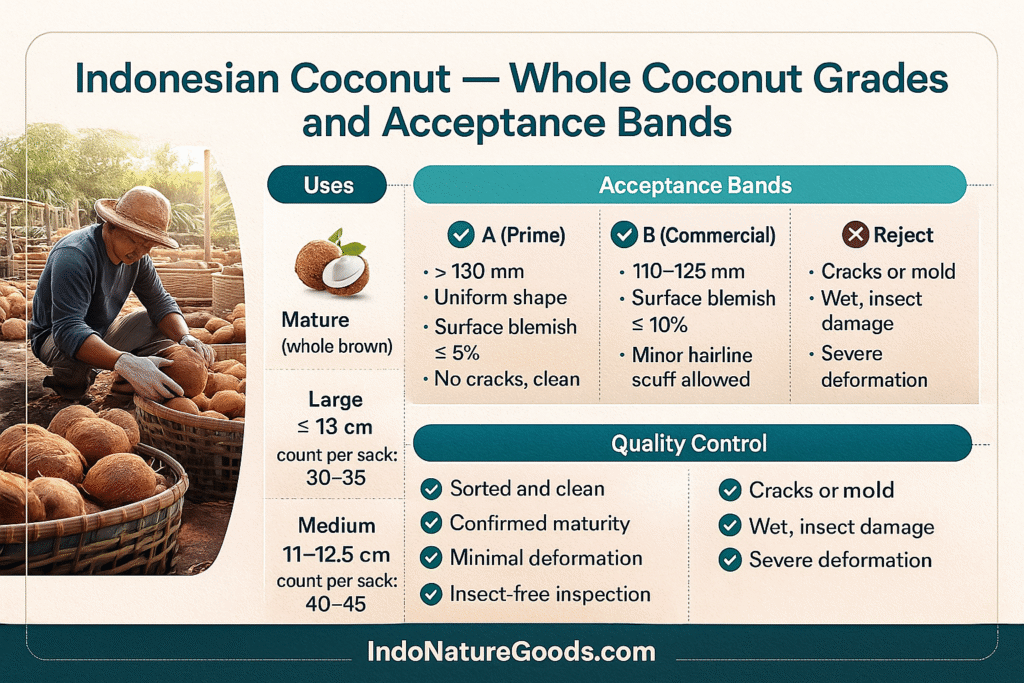
Coconut shell & crown: sound crown; no cracks; firm shell.
-
Coconut cleanliness: low surface soil; neat trim on young fruit.
-
Coconut size & weight: band target per PO; variance limits defined.
-
Coconut freshness cues: bright husk for young; dry outer husk and steady shake feel for mature.
These cues read fast for QA and intake teams.
Coconut size bands — calibration that travels across regions
Define coconut bands by weight or circumference and freeze the table at RFQ. Then publish the same table on tickets and reports. Consequently, counts stay consistent across belts.
Coconut size examples — buyer-friendly table
-
S coconut: light band for tight price points.
-
M/L coconut: core demand band for mixed programs.
-
XL coconut: display-led band for feature weeks.
Tolerance appears as a simple ± window per band.
Coconut defect list — concise language that avoids debate
Use short coconut terms on the ticket:
-
Cracked shell coconut → reject.
-
Over-trimmed crown coconut → reject.
-
Heavy soil coconut → rework clean or reject by rule.
-
Off-band size coconut → reclassify or reject.
Clear words speed decisions and protect yield.
Quality Assurance — coconut intake checks that matter
Intake uses four steps: shell condition, trim quality, size/weight band, and exterior cleanliness. Additionally, record region and harvest window on the coconut lot ticket. Therefore, lots remain comparable week to week.
Coconut trace notes — simple origin anchors
Attach region tags to each coconut lot. Consequently, teams match volumes to real harvest windows and plan displays with confidence.
Why Choose IndoNatureGoods.com (reasons for choosing) — coconut grading strengths
-
One coconut grade language across regions.
-
Fixed size tables and visible variance limits.
-
Quick tickets that pass audits.
The Human Side — coconut livelihoods behind good grading
Consistent coconut rules help harvesters and graders work faster and safer. Training improves. Income stabilizes.
How to Partner — coconut grade onboarding
-
Share coconut type (mature or young) and weekly volumes.
-
Lock size/weight bands and tolerance.
-
Approve defect list and intake steps.
-
Fix region tags on the lot ticket.
-
Run a pilot month; then scale.
Testimonials — coconut buyer remarks
“Coconut grades were clear; rejections dropped.”
“Band tables kept counts consistent across regions.”
Future — coconut grade clarity
Expect tighter band references and photo guides for whole coconut. As a result, new crews grade accurately from day one.
Final Thoughts — coconut grades that keep programs steady
Fix the bands. Use the same words. Ticket every lot. With that discipline, whole Indonesian coconut runs clean and predictable.
FAQs (5) — coconut grades
-
How do you define coconut size bands? By weight or circumference with a set tolerance.
-
Do you grade both mature and young coconut? Yes—whole fruit only.
-
Which coconut defects trigger rejection? Cracks, over-trimmed crowns, heavy soil, and off-band sizes.
-
Can we change coconut bands mid-program? Yes—after a ticket and label update.
-
Do you supply derivatives? No—this program is whole coconut only.